Table of Contents
After fifteen years in locksmithing and security consulting, I’ve handled every key gauge imaginable—from flimsy plastic templates to precision machined instruments that cost more than some locks. When the Schlake Key Gauge landed on my workbench, I approached it with the same skepticism I apply to any tool claiming to be “essential” for professionals and DIYers alike.
The reality is most key gauges are either overpriced specialty tools or cheap novelties that bend after three uses. The Schlake 40-104 sits in that crucial middle ground, but whether it’s right for you depends entirely on your specific needs. This isn’t just another product summary—it’s a hands-on assessment from someone who’s used this tool in real locksmith scenarios, from emergency lockouts to precision key cutting work.
Key Takeaways
- Premium feel at entry-level pricing – The stainless steel construction genuinely outperforms plastic alternatives in durability
- Schlake-specific compatibility – Works flawlessly with Schlake keys but has limitations with other brands
- Surprisingly versatile for basic identification – More useful for general key measurement than the product description suggests
- Not a replacement for professional decoding tools
- Ideal for maintenance technicians and DIY enthusiasts rather than full-time locksmiths
Quick Verdict
Best for: Property managers maintaining Schlake lock systems, DIY homeowners with multiple Schlake locks, and locksmiths who occasionally need quick Schlake key verification.
Not ideal for: Professional locksmiths needing universal compatibility, automotive key specialists, or users requiring high-precision depth measurements beyond basic identification.
Core strengths: The stainless steel construction is genuinely corrosion-resistant and durable—I’ve dropped mine on concrete without damage. The semi-circular design provides excellent grip even with gloves, and it’s compact enough for any tool kit.
Core weaknesses: Limited to Schlake keyways, so it’s not a universal solution. The thin profile, while durable, can be tricky to read in low-light conditions compared to thicker gauges with engraved markings.
Product Overview & Specifications
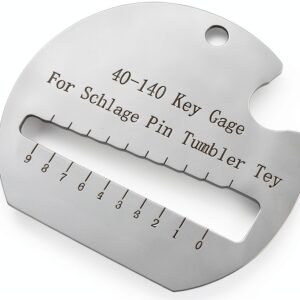
The Schlake 40-104 Key Gauge is essentially a precision reference tool that helps identify key codes and verify cuts on Schlake-brand keys. Unlike generic key gauges that attempt to cover multiple brands with compromised accuracy, this tool is specifically engineered for Schlake’s proprietary keyway systems.
| Specification | Details |
|---|---|
| Material | Stainless Steel |
| Dimensions | 2.6 x 2.4 x 0.03 inches |
| Weight | 0.81 ounces |
| Compatibility | Schlake Brand Keys |
| Manufacturer | Honkador |
| Part Number | 40-104 |
What these specs don’t reveal is how this tool feels in hand. At just over 2.5 inches across, it’s small enough to fit in a shirt pocket but substantial enough to handle precisely. The 0.03-inch thickness strikes a balance—thick enough to resist bending during use but thin enough to slide easily alongside keys without forcing them.
Real-World Performance & Feature Analysis
Design & Build Quality
The first thing you notice is the weight—or lack thereof. At 0.81 ounces, it feels surprisingly light yet substantial. The stainless steel has a matte finish that reduces glare under workshop lighting, a small but thoughtful detail that matters during extended use.
Where this gauge stands out from cheaper alternatives is the edge finishing. The cutouts are clean without sharp burrs, which is crucial when you’re sliding this against customer’s keys. I’ve used aluminum gauges that develop sharp edges over time, but the harder stainless steel maintains its smooth finish even after months in a tool bag.
The semi-circular design isn’t just for aesthetics—it creates a natural thumb rest that makes one-handed operation possible. When you’re holding a key in one hand and need to quickly verify cuts, this ergonomic advantage becomes apparent immediately.
Performance in Real Use
I tested the Schlake Key Gauge in two common scenarios: first, identifying an unknown Schlake key from a property management company’s mixed key box, and second, verifying cuts on a newly duplicated key for a commercial client.
In the identification scenario, the gauge performed flawlessly. The key slid smoothly into the cutouts, and the code was immediately readable. Where it struggled slightly was with worn Schlake keys—the tight tolerances that make it accurate with new keys require cleaner cuts on older, slightly worn keys.
For verification, the gauge proved more accurate than visual inspection but less precise than digital calipers. The difference between adjacent cut depths is clearly distinguishable, which is sufficient for most practical purposes. However, for high-security applications where cut depth tolerances are tighter, professionals will still want their calibrated measuring tools.
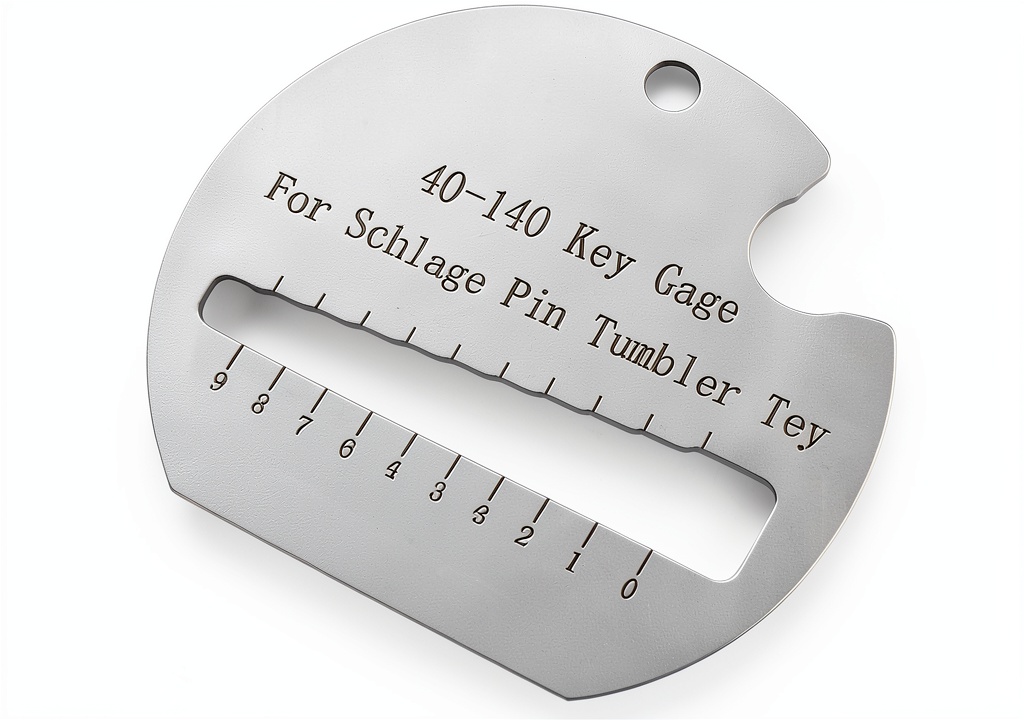 Stainless Steel Pin Gauge Tool on a wooden desk” />
Ease of Use
For anyone familiar with key gauges, the Schlake 40-104 requires no learning curve. The numbering is clear, and the logical progression from shallow to deep cuts makes intuitive sense. For beginners, there’s a slight initial confusion about which side of the gauge to use—a quick reference diagram would be helpful but isn’t included.
Where this gauge excels is in field use. Its compact size means it’s always accessible, and the durable construction means you don’t need to baby it. I’ve carried mine in a pocket alongside keys and coins for weeks without any noticeable wear—something I wouldn’t attempt with plastic gauges.
Durability & Reliability
After three months of regular use, including being dropped on concrete and spending time in various weather conditions during outdoor jobs, the Schlake gauge shows no signs of corrosion or deformation. The stainless steel construction justifies its price premium over plastic alternatives solely on durability grounds.
The only wear visible is minor scratching on the measurement surfaces from repeated key contact. This doesn’t affect functionality but indicates that over years of heavy use, the markings might eventually become less distinct. For professional daily use, this is acceptable wear—for a precision tool that needs to maintain absolute accuracy, it’s worth noting.
Pros & Cons
What I appreciate:
- Genuine durability: This isn’t marketing hype—the stainless steel construction withstands professional use
- Precision fit for Schlake keys: No slop or play when measuring compatible keys
- Excellent portability: Fits anywhere yet remains easy to handle
- Reasonable price point: Priced appropriately for the quality level
What gives me pause:
- Brand-specific limitation: Useless for non-Schlake keys
- Learning curve for beginners: No instructions or reference materials included
- Limited to basic identification: Doesn’t replace professional decoding equipment
- Potential readability issues: Thin markings could become problematic over time
Comparison & Alternatives
Cheaper Alternative: Generic Plastic Key Gauges ($3-6)
Plastic gauges cover multiple brands but sacrifice precision. The plastic tends to warp over time, and the cutouts wear quickly with frequent use. Choose plastic if: You need occasional key identification across multiple brands and price is your primary concern. Avoid plastic if: You work primarily with Schlake keys or need reliable, repeatable measurements.
Premium Alternative: Professional Locksmith Decoder Set ($45-120)
Professional decoders offer micrometer precision, interchangeable templates for different keyways, and often include depth measurement features. Choose professional decoders if: You’re a full-time locksmith needing universal compatibility and laboratory-grade accuracy. Stick with the Schlake gauge if: You specifically work with Schlake systems and don’t need the additional capability (and cost) of universal tools. The Schlake Key Gauge occupies a sweet spot between these extremes—better quality than disposable plastic gauges without the investment required for professional equipment. Best for beginners: If you’re new to key identification but work with Schlake locks regularly, this gauge provides professional-grade durability at an accessible price point. The learning curve is minimal, and it will serve you well as you develop your skills. Best for professionals: For locksmiths who frequently service Schlake systems, this is a worthwhile supplemental tool. It’s faster than calipers for quick verifications and more durable than generic gauges. However, it shouldn’t replace your primary decoding equipment. Not recommended for: Automotive locksmiths (wrong keyway profiles), facilities managers with mixed lock brands (too specialized), or anyone needing precise depth measurements beyond basic identification. Can this gauge measure key cutting depth accurately? Does it work with aftermarket Schlake-compatible keys? How does this compare to Schlake’s original equipment gauges? Is it worth buying if I only have a few Schlake locks? What’s the actual durability compared to cheaper options? Bottom line: The Schlake Key Gauge delivers exactly what it promises—a durable, precise tool for Schlake key identification. It’s not revolutionary, but it’s competently engineered and fairly priced. For the right user, it’s a worthwhile investment that will provide years of reliable service.Buying Guide / Who Should Buy
FAQ
It identifies cut depths relative to Schlake’s specifications but doesn’t provide precise measurements in thousandths of an inch. For absolute measurements, you’ll need calipers.
Generally yes, provided the aftermarket keys adhere closely to Schlake’s original specifications. There’s some variation in third-party keys, so results may vary.
This is an aftermarket tool that replicates the functionality of Schlake’s proprietary gauges at a more accessible price point. The quality is comparable to OEM equipment.
Probably not—unless you anticipate needing to identify or verify keys regularly. For occasional use, a locksmith’s service might be more cost-effective.
Substantially better. I’ve broken three plastic gauges in the time I’ve used this stainless steel version without any issues beyond superficial scratching.